Showing posts with label Maya. Show all posts

Saturday, January 23, 2016

Yucatán Road Trip: Dzibilchaltún


On the morning of our first full day in Mérida, we hopped back in the car and headed north of the city to Dzibilchaltún.

Located on a hot, dry plain about 22 km south of the coast, Dzibilchaltún has the honor of possessing the least picturesque ruins of the 20-plus Maya sites we visited. However, what the destination lacks in architectural or decorative splendor it makes up for in historical importance and, thanks to its cenote, natural beauty. The on-site museum—which consists of both indoor and outdoor displays of artifacts, stelae, and anthropological installations—is also quite good and added significantly to our appreciation of the site.

First occupied around 800 BCE, Dzibilchaltún was one of the earliest major settlements on the peninsula. As a result, some of the oldest known ceramics of the region come from here. The local economy was based on salt trade, and the relative strangeness of the city's location—which is both inhospitable and fairly far from the sea—can be understood as a compromise between finding land that was as close to the salt-producing coastal lagoons as possible while simultaneously capable of supporting a minimal amount of agricultural cultivation. Of course, the presence of a cenote, offering fresh water in an otherwise arid environment, would have been a key factor in the choice of locale as well.


At one end of the traversable ruins stands the site's most iconic building, the Temple of the Dolls. Named for the seven, rough, ceramic figures once buried in front of its altar and now on display in the museum, the temple sits in near isolation at one end of a large, open plaza. Doors located at the center of each of sanctuary's four walls heighten the effect of the square building's rather unusual radial symmetry, while skeletal remnants of Chaac masks sit above these entrances and at the roofline's four corners. Like many surfaces at the site, the masks (and numerous nearby stelae) were once covered in sculptural, painted stucco. Archaeologists have discovered graffiti inside the temple as well, some of which may date to 1200–1520 CE, when Maya pilgrims reopened and restored the sanctuary. Unfortunately, the building itself is no longer accessible and must be appreciated from a distance.


Running east-west, a long, straight sacbe connects the Temple of the Dolls to Dzibilchaltún's central square. Visitors can either follow this road to the rest of the site or take or a parallel (and more shaded) path part of the way. Walking down the sacbe will also lead visitors past another, circular path that leads to very little.


The central plaza consists of a few, spread-out structures, including a small pyramid, an open Franciscan chapel, stone bleachers, and a gateway. On the other side of the gateway lies the Xlacah Cenote, perhaps the site's greatest highlight.


Swimming is allowed, albeit "at your own risk," but there is no changing room or shower on the grounds.

As an oasis in an otherwise parched landscape, the water here is teeming with life. During our visit, the pool seemed especially hospitable to lily pads and various fish, the latter of which struck us as a little too eager to swarm a bit of flesh and check it for possible food. We spent the majority of our time at Dzibilchaltún admiring the cenote and its surrounding flora and fauna, but left the swimming for another day.

Although I don't imagine myself feeling the need to return to Dzibilchaltún, the cenote and museum alone made it worth a visit. If you go, arrive early to beat the tourist groups bused in from Mérida. There is no escaping the sun, so having a hat, sunblock, and plenty of water is especially important here.

Highly subjective personal rating: 7/10 
[ruins: 5/10; cenote: 8/10; museum: 8/10]


All photographs by Renée DeVoe Mertz, May 21, 2015.

Monday, January 11, 2016

Yucatán Road Trip: Façades of Mérida (and the tricky morality of tourist economics)


It was already late afternoon by the time we escaped Balankanché, prompting us to once again skip the cenote on the day's itinerary and drive straight to our next hotel. This time we were headed to Mérida, the capital and largest city of the state of Yucatán.

Driving and parking in central Mérida is not fun—the roads are narrow, mostly one-way, and frequently filled with cars as well as pedestrians spilling over from the equally crowded sidewalks. Many hotels will have special deals worked out with specific lots, and it helps to know ahead of time which parking lot is affiliated with your hotel. Otherwise, look for the estacionamento signs (sometimes simply indicated by an E in a red circle), find one near where you will be staying, and just know that you will pay for an hour or so before you can come back and move your car to the appropriate lot.

Once you're settled-in, the city will reward your effort to be there. At least for a day or two. Mérida is home to good shopping, numerous restaurants, a few solid museums, and faded glories of colonial architecture. It also lies in proximity to a number of Maya ruins (day trips to the World Heritage sites of Chichén Itzá and Uxmal are available from the city) as well as to the sea. As a result, the city is a popular stop for cruise lines, and during the day many tourists will come ashore to acquire relatively inexpensive, locally made goods, including jewelry, masks, wide-brimmed hats, embroidery, and other textiles. Even Josh and I, who had not planned on shopping at all, ended up contributing a fair amount to the local economy.


I should probably note here that Americans and Europeans often feel taken advantage of in Mexico, especially in larger cities like Cancún and Mérida. Sometimes such feelings are the result of misunderstandings born out of overlapping but ultimately very different cultural economics. Sometimes they are the result of one person actually taking advantage of another. As a foreigner, you are certainly a target for vendors and guides who rely on the money of tourists for their own survival. That can get very old very fast, especially as you hear the same lines again and again. For instance, nearly everyone claims that what they sell is "authentic" and that everything sold everywhere else is "fake." Without being an expert myself on Maya goods, I can only advise that whatever you hear—from angry tourists and hungry vendors alike—take it with a grain of salt.

After finally checking-in to the hotel, the friendly guy attending the front desk pointed us towards a nearby collective, where, he claimed, proceeds from sales were redistributed to all of the participating artists in an effort to support the local communities as a whole. True? Nope. That is, not according to the many fuming reviews I have since read on TripAdvisor. But at the time, trusting both our hotel and the seemingly sincere man we met at the store itself, we ended up purchasing a few pieces of opal jewelry (mostly as gifts) for decent prices. Were the stones authentic? I fear the answer to that is also nope, despite the certificates accompanying each piece. One of these days I will screw up my courage and have mine appraised, but in the meantime I've decided to just enjoy them both as the pretty trinkets they are and as the gentle reminders of the fallibility of my own judgement they have become.


On our second night, we allowed another man to draw us into his store for jipijapas (aka, Panama hats, made from jipijapa palm leaves), hammocks, and clothing woven with sisal. In addition to being light, strong, flexible, and breathable, the fibers of both the palm and sisal are supposed to possess properties of a natural bug repellant—all highly desirable features during a Yucatán spring. Unlike most touristy items, such products are actually popular with locals, and the hats especially were essential wearing for anyone working in the sun.

We chatted with the owner for a while, and as we tried on items he showed us pictures of himself and his associate as a child and young man, respectively, working in the caves where jipijapas are made. He explained that manipulating the fibers requires the damp, warm environment of the caves, just as the finest weaving on the top of the hat requires the small hands of children and women. Because of the poor air quality, hat makers can only remain underground for a few hours a day.

I think he told us all of this to illustrate the communal nature of his store, to convince us of the specialness of the hats, and to illustrate why they were worth the amount he was asking for them (the equivalent of about $40 each). Outwardly, we tried not to disappoint him with our reactions. Inwardly, the actual effect of his story was somewhat different. Having just spent an hour ourselves in a Yucatán cave, the idea of anyone, especially children, working in such conditions was wrenching. The realization that by purchasing the hats we would be supporting such a system was horrifying. And yet, if we didn't buy anything, those same people would be that much worse off due to the lack of income from their labor.

Intellectually, of course, I know that we all participate in similarly fraught economic situations everyday. But as an American, it is rare to have the system laid so bare before you, to see so clearly how inescapable it is, or to be so close to the people most affected by the terrible dichotomy of life saving/life endangering work. I am still not sure what the right thing to do actually was.

In the moment, however, we chose the easier path of the more immediate good, and are now the (conflicted) owners of two very nice jipi hats.

Since returning home, I have come across a few reviews by scorned tourists challenging the notion that jipijapas are constructed in caves. I would love for that to be true. Unfortunately, as documented here, the practice seems to be alive and well, although in Becal such caverns may be man-made and not nearly so deep as the likes of Balankanché. Perhaps that makes all the difference? Or is that idea just another scam, one we try to sell to ourselves to make our own lives a little more comfortable?


Thursday, December 31, 2015

Yucatán Road Trip: Balankanché

Incensors around a naturally formed column representing the Ceiba, or World Tree, Balankanché.
Photo by Renée DeVoe Mertz, May 20, 2015. 

Over the course of my various travels, there have been five moments when it occurred to me that I had put myself in a situation where I might die. The first took place in London, during a late night stroll along the bank of the Thames. The second was in Taiwan, sitting at the front of a bus making its way down the winding sliver of a cliffside road inside Taroko Gorge. The third and fourth were both in planes during storms, one while flying through the edge of a typhoon over the Pacific, the other in a much smaller aircraft over the Midwestern United States. And the fifth instance happened this spring, during a tour of Balankanché caves.

Located about 4.5 km southeast of Chichén Itzá off highway 180, the site of Balankanché had been used, off and on, since at least the Late Preclassic (300 BCE—250 CE) until the fall of Chichén. As a sacred site, the many clustered, in situ artifacts consist of implements for rituals. Incense burners—several of which possess semi-abstracted faces—are particularly, and unusually, abundant. 

The cave itself is essentially T-shaped, with the central passage culminating in a chamber dominated by a naturally forming column and stalactites that together resemble the trunk and hanging branches of a great, subterranean tree. To the Maya, this formation represented the World Tree, or Ceiba, which connected the three layers of the universe: heaven, the middle (terrestrial) world, and the underworld. The raised ground around the bottom of the "tree" is heavily dotted with incensors and may have been used as an altar.   

Having grown up in an area similarly situated on limestone, and thus similarly punctuated by caves and sinkholes, I was particularly excited by the possibility of visiting this site. However, my experiences with the cool environments of caverns in the US colored my expectations of what the Yucatán counterparts would actually be like. Despite having read that the air would be warm and humid, and that the "major danger" archaeologists faced "during the exploration was lack of oxygen," my brain somehow never accepted what this had to mean for our own visit until we were actually in the tunnels themselves [Coe 2001, 399].

We arrived at the site after spending the morning and early afternoon in the sun at Chichén Itzá. Fortunately, the air conditioning in the car had already provided some much welcome relief from the heat and helped revive our energy for this next adventure. Upon our approach, though, we learned that we were the only people at the welcome center, and the next tour wasn't scheduled for another 45 minutes. Waiting was a gamble, as the site's policy is to only take groups of five or more into the caves; if no one else came, we would have wasted our limited time. Spurred on in my enthusiasm by wishful optimism, I assumed more people would show up closer to the time of an actual tour, and so we opted to wait. And then, when the tour time came and went and still no one else had arrived, we waited a little longer. Finally, after almost an hour and a half, we decided to leave and try to salvage the rest of our afternoon by visiting the nearby Ik Kil cenote. As we got up to leave, the man supervising the site stopped us and offered to let us go if we paid for two extra people. We agreed, albeit a little reluctantly, and he called over one of the guides to take us through.

At this point, I was a little annoyed. After all, there were three guys, including our own guide, who had been waiting the whole time we were there to lead people into the caves. Surely, I thought, it was better for them to take two people rather than no one at all. Making us wait and then pay extra felt a lot like getting fleeced. But we had already invested the time, and not going would have been the second major disappointment of the day. So we sucked it up and determined to make the most of the opportunity we had.

Our guide was perfectly pleasant, although he spoke very little and led us quickly through rising and falling tunnels. At first I wished he would slow down so we could better take-in the surroundings; 20 minutes later, I wished we could somehow go even faster. His job was not so much to provide information or guidance (the piped-in dramatic voices near the entrance and installed electrical lighting did that) as it was to occasionally draw our attention to the major points of interest within the caves. It was also, I soon understood, to make sure we didn't somehow get lost or pass-out. 

There is only one entrance into the caves, which means that there is only one source of fresh air. As we made our way further underground and further from this opening, the atmosphere became steadily hotter and more humid. Eventually, it felt as if we were walking through water, and I found myself unable to get enough oxygen into my lungs. Stopping did not help. The only way to get the O2 I so desperately wanted was simply to keep walking until conditions improved. The effect lessened somewhat—although not enough to breathe comfortably—when we reached the Ceiba, and we paused there (for as few minutes as possible) to take pictures. We then went a little further into one of the branches of the "T," but my memories of what we saw are hazy at best. I do recall, however, my intense relief when I realized we were heading back and my even greater relief when we stumbled out into the open air. There were several moments, both going and coming, when I had to suppress waves of panic, and I was thankful to have both Josh and our guide there. Knowing that they, too, were having trouble breathing reassured me that the issue was environmental and not personal (ie, I was not having a heart attack) and that if we just kept going we would make it through.

Even so, it took several hours after leaving the site for the squeezing sensation in my lungs to go away and for my breathing to return to normal. I'm also embarrassed to say that although we finally appreciated the reasonableness of their five-person minimum policy, in our lightheaded, respiratory desperation and general desire to escape the site, we forgot to tip our guide. This was the worst tipping mistake of our trip, and the one thing I most wish we could go back and change. 

Ultimately, although I am glad we went, I don't foresee ever returning to Balankanché and would only recommend it to the physically sturdy with a strong interest in Maya culture and archaeology. 

Highly subjective personal rating: 6/10 


Monday, December 21, 2015

Yucatán Road Trip: Chichén Itzá


The Post-classic Maya city of Chichén Itzá ["beside the well of the Itza"] is not only a UNESCO World Heritage site but also, since 2007, one of the "new" seven wonders of the world. It is also a fairly easy day trip from either Cancún or Mérida, and is thus one of the most visited archaeological sites in Mexico, if not the world. 

Although it is often referred to as a Maya-Toltec settlement, the history of the city and its associated architecture is still contested. The more traditional view, and the one presented on the associated UNESCO webpage, is that the original Classic period settlement was conquered by the Toltecs, and that most of the major buildings now associated with the city represent a fusion of the two cultures. This narrative dovetails nicely with a Maya legend of the arrival of a king from Central Mexico, identified as Kukulkan (Feathered Serpent), and goes some way in explaining the predominance of plumed snakes in Chichén Itzá's architecture, as well as the inclusion of other features more associated with central Mexican cultures, including images of death and sacrifice.   

Detail of the relief along Chichén Itzá's Great Ball Court. The kneeling figure on the left depicts the game's decapitated loser; the snakes springing from his neck represent blood spurting from the wound. Photo by Renée DeVoe Mertz, May 20, 2015. 
There are, however, problems with this theory. The most significant issue is a matter of timing—namely, archaeologists now believe that the buildings once thought to represent Toltec features actually pre-date the civilization which supposedly influenced them [Drew 1999, 371]. If true, this might point to a reversal of influence, in which the Toltecs incorporated imagery from the Maya, not the other way around. Indeed, many of the supposedly "Toltec" aspects of Chichén Itzá are in fact present in other, earlier Maya settlements. The feathered serpent, for instance, was already a common motif in Maya culture centuries before the establishment of the great centers of the Yucatán, and can be traced to even earlier origins within the Olmec civilization. Likewise, clear evidence of the importance of war and the practice of human sacrifice at Classic period settlements, such as the murals of Bonampak, have long since forced archaeologists to set aside more romantic notions of the Maya as an idilic civilization of peaceful scholars corrupted by blood-thirsty outside conquerers. 

Regardless of who was responsible, the great architecture of Chichén Itzá is both physically imposing and iconographically impressive. Since the site's inclusion as one of the wonders of the world, however, access has become increasingly restricted. Visitors can no longer climb the stairs of El Castillo or enter its interior chambers, nor can they walk among the many columns of the Temple of the Warriors. 

360-panorama of the Temple of the Warriors and El Castillo, Chichén Itzá, by Joshua Albers, May 20, 2015.
Back in 1999, I had the opportunity to climb the pyramid and chose not to. This time, I promised myself I would brave the heat and precarious steps in order to take a peek at the inner chamber. To this end, we arrived early and made a beeline from the entrance directly to El Castillo. After months of anticipation, it took me a while and multiple laps around the foot of the pyramid to accept the eventual realization that I had forever missed my chance to see the temple interior. Putting aside my personal disappointment, however, these new measures are clearly important precautions for preserving the heavily visited ruins, and ones the government has been wise to undertake.

That being said, missing this opportunity definitely increased the pressure to do everything we could at the subsequent, less regulated, sites we visited.

Another consequence of being a popular tourist destination is the inclusion of many artisans and souvenir sellers scattered amongst the shaded areas of the grounds. This feature is somewhat unique to Chichén Itzá, as other sites either require such stalls to be outside of the grounds—as at Tulum—or simply don't draw enough people to have more than one or two merchants present, if there are any at all.


Artist Efrain Cetz beside his masks and other carvings, Chichén Itzá. Photo by Renée DeVoe Mertz, May 20, 2015.
The wares on offer vary greatly, from mass-produced or poorly made souvenirs to unique objects crafted by skilled artists. If you are interested in making a purchase, it's probably best not to buy the first thing that catches your eye, as many vendors will have similar—and possibly better-constructed—items for sale. But if, after looking around, you do find something you like, buy it. We ended up purchasing a mask by Efrain Cetz there, and although it took at least a half hour and the last of our energy to find him again, I'm glad we did. For while we later saw other, vaguely similar, masks elsewhere, they never appealed as much as the one we already had. In addition, buying directly from the artist allowed us to speak with him about his ideas and practice, which in turn gave us a better appreciation of not only what we were taking home, but of how traditional Maya stories and concepts are being reinterpreted by contemporary people.

Masks of the rain god, Chaac [Chac, Chaahk], adorning the Puuc-style "Church," Chichén Itzá. Photo by Renée DeVoe Mertz, May 20, 2015.
Finally, as a heavily visited, imminently photogenic location, Chichén Itzá is also one of the most photographed places on the planet. There is almost no angle of the extensive grounds that has not already been captured multiple times, and no shortage of images available in publications and on the web. Not that the futility of trying to take an original picture stopped us from spending hours snapping hundreds of our own photos. But because images of the major buildings are so common, we mostly focused on framing our own impressions, using our telephoto lenses to better see the details we couldn't approach, and documenting the many iguanas chilling at the site like giant, scaly squirrels. 

She knows she's beautiful.
For more on the site's layout, history, and visiting information, see the INAH website, which has text in both English and Spanish.


Highly subjective personal rating: 9/10 [Bucket-list worthy]


Tuesday, February 14, 2012

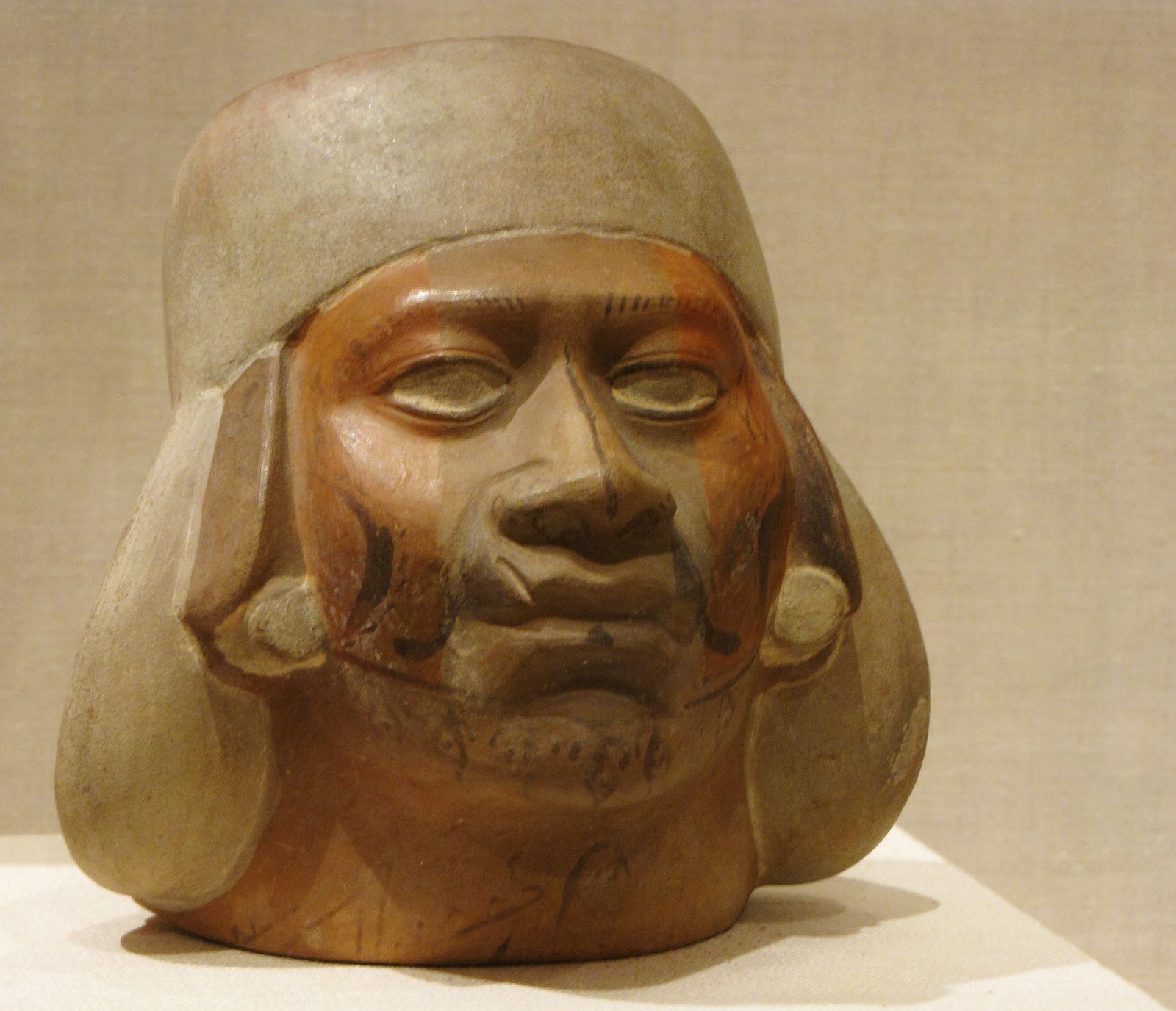
Portraits of the Ancient Americas Galleries at the Art Institute of Chicago

Vessel in the Form of a Seated Ruler with a Pampas Cat, ceramic and pigment, 250/550 CE, Moche; North coast, Peru 

 Bowl Depicting a Mask (Possibly a Katchina), above an Abstract Bighorn-Sheep Head, ceramic and pigment, 1300/1400 CE, Four Mile Polychrome, White Mountain Redware; Cibola region, east-central Arizona, United States 

Figure of a Woman in Ceremonial Dress, ceramic, 700/900 CE, possibly Totonac, Nopiloa; Veracruz, south-central Gulf Coast, Mexico

Seated Joined Couple, ceramic and pigment, 200 BCE/300 CE, Nayarit; Nayarit, Mexico

 Miniature Mask, wood, gold foil, shell, pigment, and resin, 1300/1400 CE, possibly Mixtec; possibly northern Oaxaca, Mexico

 Standing Figurine with Missing Leg, jade, 800/400 BCE, Olmec; Guerrero, Mexico

Vessel Depicting a Mythological Scene, ceramic and pigment, 600/800 CE, Late Classic Maya; Petén region, Guatemala 

 Portrait Vessel of a Ruler, ceramic and pigment, 100 BCE/500 CE, Moche; North coast, Peru

 Head Fragments from Large Ceremonial Jars, ceramic and pigment, 700/800 CE, Tiwanaku-Wari; Pacheco, south coast, Peru

Hieroglyphic Panel, limestone, 650/800 CE, Late Classic Maya; Usumacinta River area, Mexico or Guatemala

Storyteller Figure, ceramic and pigment, 100/800 CE, Jalisco; Ameca Valley, Jalisco, Mexico

Vase of Seven Gods, Ah Maxam (active mid-late 8th century), ceramic and pigment, 750/800 CE, Late Classic Maya; vicinity of Naranjo, Petén region, Guatemala

Bowl Depicting a Hero-Hunter with a Heron Headdress, Bow, and Arrows, along with a Rabbit Hunter; ceramic and pigment (Classic Mimbres Black-on-white); Mimbres branch of the Mogollon; New Mexico, United States

 Mosaic Disk with a Mythological and Historical Scene, turquoise, shell, and sandstone, 1400/1500 CE, Mixtec; Northern Oaxaca, Mexico

Mask from an Incense Burner Portraying the Old Deity of Fire, ceramic and pigment, 450/750 CE, Teotihuacan; Teotihuacan, Mexico

Ballcourt Panel, limestone, 700/800 CE, Late Classic Maya; possibly La Corona, Usumacinta River area, Guatemala

Figurine of an Aristocratic Lady, ceramic and pigment, 650/800 CE, Late Classic Maya, Jaina; Campeche or Yucatán, Mexico

Vessel of the Dancing Lords, Ah Maxam (active mid-late 8th century), ceramic and pigment, 750/800 CE, Late Classic Maya; vicinity of Naranjo, Petén region, Guatemala

 Ritual Impersonator of the Deity Xipe Totec, ceramic and pigment, 1450/1500 CE, Aztec; possibly central Veracruz, Mexico

Female Figurine, ceramic and pigment, 500/400 BCE, Tlatilco; Tlatilco, Valley of Mexico, Mexico

Vessels, ceramic and pigment, Late Classic Maya, Mexico or Guatemala

Stela, limestone, 702 CE, Late Classic Maya; vicinity of Calakmul, Campeche or Quintana Roo, Mexico

 Jar in the Form of a Standing Figure, ceramic and pigment, 100 BCE/500 CE, Moche; North coast, Peru

Female Effigy, terracotta and pigmented slip, 200/100 BCE, Chupícuaro; Guanajuato or Michoacán, Mexico

Standing Male Figure, ceramic and pigment, 650/800 CE, Late Classic Maya, Jaina; Campeche or Yucatán, Mexico

 Pendant in the Form of a Figure, shell stone, silver, copper, and cotton, 400/800 CE, Tiwanaku-Wari; coastal Peru or highland Bolivia

Carved Vessel Depicting a Lord Wearing a Water-Lily Headdress, ceramic and pigment, 600/800 CE, Late Classic Maya, Chocholá; Yucatán or Campeche, Mexico

 Portrait Vessel of a Young Man with a Scarred Lip, ceramic and pigment, 100 BCE/500 CE, Moche; North coast, Peru

 Bowl Depicting a Harvest Dance, ceramic and pigment, 180 BCE/500 CE, Nazca; South coast, Peru

Portrait Vessel of a Man with a Cleft Lip and Tattoos, ceramic and pigment, 100 BCE/500 CE, Moche; North coast, Peru 

 Pedestal Bowl, ceramic and pigment, 1100/1300 CE, Coclé; possibly La Peña, Veraguas province, Panama

 Vessel Depicting a Prisoner with Avian Captors, ceramic and pigment, 100 BCE/500 CE, Moche; North coast, Peru

 Vessel in the Form of a Llama, ceramic and pigment, 100 BCE/500 CE, Moche; Chimbote, Santa Valley, Peru

 Portrait Vessel of a Ruler, ceramic and pigment, 100 BCE/500 CE, Moche; North coast, Peru

Rattle in the Form of a Mythological Figure, ceramic and pigment, 650/800 CE, Late Classic Maya, Jaina; Campeche or Yucatán, Mexico

 Vessel in the Form of a Royal Messenger, ceramic and pigment, 100 BCE/500 CE, Moche; North coast, Peru

Figure of a Standing Warrior, ceramic with pigment, 650/800 CE, Late Classic Maya, Jaina; Campeche or Yucatán, Mexico

 Vessel in the Form of a Courtly Musician, ceramic and pigment, 100 BCE/500 CE, Moche; North coast, Peru 

 Vessel in the Form of a Warrior, ceramic and pigment, 100 BCE/500 CE, Moche; Chimbote, Santa Valley, north coast, Peru

 Drinking Cup (Kero) with an Abstracted Masked Figure, ceramic and pigment, 600/1000 CE, Tiwanaku-Wari, Bolivia or Peru

 Bowl Depicting a Swarm of Mice, ceramic and pigment, 180 BCE/500 CE, Nazca; South coast, Peru

 Double Pendant in the Form of a Mythical Caiman, gold with plaster restoration of boar tusks, 800/1200 CE, Coclé; Coclé province, Panama

Vase of Seven Gods, Ah Maxam (active mid-late 8th century), ceramic and pigment, 750/800 CE, Late Classic Maya; vicinity of Naranjo, Petén region, Guatemala

Mantle (detail), camelid wool, 100 BCE/200 CE, Paracas Necropolis; Paracas peninsula, south coast, Peru

Double-Spouted Vessel Depicting Ritual Masks, ceramic and pigment, 180 BCE/500 CE, Nazca; South coast, Peru 

 Pedestal Bowl, ceramic and pigment, 700/1100 CE, Coclé; possibly Los Santos province, Panama

 Jar in the Form of a Seated Figure, ceramic and pigment, 100 BCE/500 CE, Moche; North coast, Peru


All photos by author

Contributors

Followers